
Two Caterpillar 313GR Excavators Shipped to Colombia via Flat Rack from Yokohama — Full Process Inside
Another shipment out the door — and this one was a particularly satisfying one to put together.Two units of the Caterpillar 313GR hydraulic excavator, freshly...
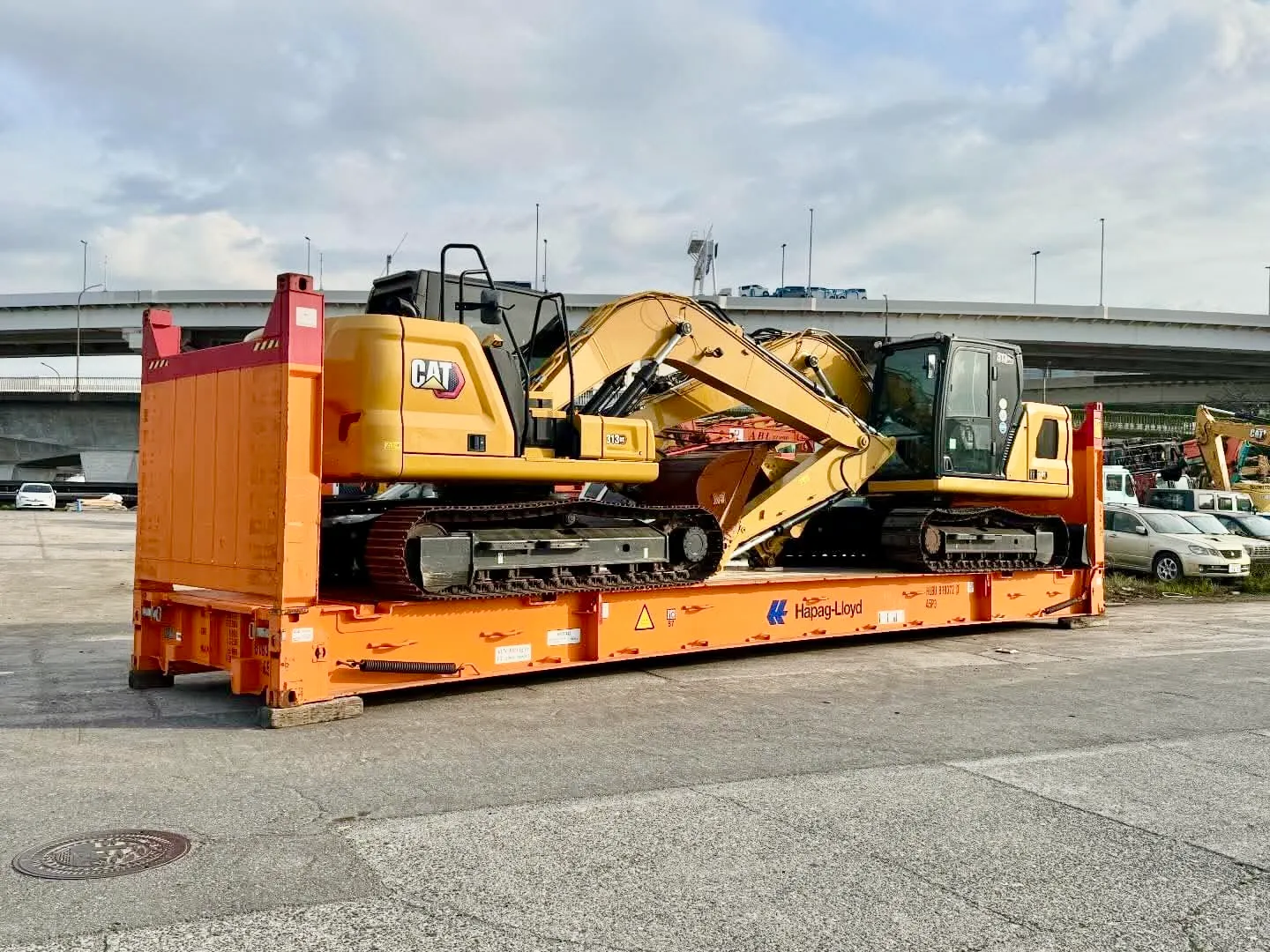
Another shipment out the door — and this one was a particularly satisfying one to put together.
Two units of the Caterpillar 313GR hydraulic excavator, freshly prepared at our yard, loaded onto flat rack containers, and on their way from Yokohama Port to Colombia. From the first inspection to the moment the vessel left port, our team handled every step in-house, and we wanted to walk you through exactly how it all came together.
Whether you're a buyer in Colombia, Ecuador, Peru, Panama, or anywhere else in Latin America — or you've been searching for a reliable exporter who can handle flat rack shipments from Japan — this post is for you.
About the Machines — Caterpillar 313GR
The Cat 313GR is part of Caterpillar's next-generation excavator lineup — one of the most in-demand used excavators in export markets across Latin America, Southeast Asia, and Africa.
Compact enough for urban job sites, yet powerful enough for serious earthmoving, the 313GR punches well above its weight class. Our customer in Colombia specifically requested this model for infrastructure and road construction projects, were versatility and fuel efficiency matter most.
Key Specifications:
Model Caterpillar 313GR
Operating Weight Approx. 13,500 kg
Engine Cat C3.8 | 70.3 kW / 94.2 hp
Bucket Capacity 0.53 m³
Transport L×W×H 7.69 m × 2.49 m × 2.82 m Units Shipped 2 Machines
Destination Colombia
Port of Loading Yokohama, Japan
Shipping Method Flat Rack Container
Why Flat Rack? Choosing the Right Shipping Method
This is a question we get asked a lot, so let's address it directly. The 313GR — especially with the boom and arm attached at certain angles — can present clearance challenges inside standard containers. Beyond dimensions, flat rack also gives us more flexibility when it comes to securing the machines safely for a long ocean voyage. For this shipment, we opted for flat rack containers out of Yokohama Port, one of Japan's primary export hubs for heavy machinery.
Flat Rack vs. Standard Container — Quick Comparison
Flat Rack:
Open sides & top — ideal for oversized/awkward cargo. Allows crane loading from multiple angles. Better lashing access for heavy equipment. Preferred for customs inspection. Slightly higher freight cost, but right choice for high-value machines.
Standard FCL:
Best for smaller excavators (under ~10–12 ton). More economical per unit. Better weather protection during transit.
For the 313GR → Colombia Flat rack was the right call — no question.
Step 1 — Pre-Export Inspection and Condition Check
Before anything else, both machines went through a thorough pre-export inspection at our yard. We check everything: hydraulic hoses, undercarriage condition, engine operation, travel motors, swing bearing, bucket and pins, and the overall structural integrity of the boom and arm. Any wear items that could cause issues during customs inspection at the destination port are flagged at this stage. Both units passed cleanly. Our inspection report — with photos and written notes — was compiled and sent to the buyer ahead of shipment, so there were no surprises on arrival. This step is non-negotiable for us. We've seen too many buyers elsewhere receive machines that looked clean in photos but showed up with hidden issues. That's not how we operate.
Step 2 — Cleaning and Soil Removal
Here's where a lot of exporters cut corners — and where we don't. Colombia, like many countries in Latin America, enforces strict biosecurity regulations on imported used machinery. Any trace of soil, mud, plant material, or biological matter found on arrival can result in the machine being held at port, subject to mandatory fumigation, or in serious cases, refused entry entirely.
• High-pressure washing of the entire undercarriage, tracks, rollers, and sprockets
• Removal of all soil and debris from the bucket, arm, and boom
• Cleaning of the engine bay, cab exterior, and frame
• Final visual inspection to confirm no soil remains before documentation
Both machines were cleaned to a standard that would satisfy even the strictest port inspection — because that's the only standard worth having.
Step 3 — Certificates and Export Documentation
Getting the paperwork right is just as important as getting the machines right. For this shipment, the full documentation package included:
Radiation Safety Certificate:
All used machinery exported from Japan is required to carry a radiation safety certificate confirming that radiation levels are within internationally accepted limits. This has been standard practice since 2011 and is now a baseline requirement for importers in most countries, including Colombia. We arrange this through a certified third-party inspection agency — both units passed without issue.
Phytosanitary / Cleaning Certificate:
Following the cleaning process, a phytosanitary certificate was issued confirming that the machines were free of soil, biological matter, and invasive species. This is a critical document for clearing Colombian customs and is often required by the destination port authority before offloading is permitted.
Export Customs Declaration (Japan):
All machinery was properly declared through Japanese customs with full and accurate HS codes, declared values, and machine details. Accurate export customs documentation from the origin country is the foundation of a clean import process at the other end.
Bill of Lading, Invoice, and Packing List:
The full commercial documentation package — commercial invoice, packing list, and original bill of lading — was prepared and dispatched to the buyer promptly after vessel departure, allowing them to begin the import clearance process without delay.
Step 4 — Flat Rack Loading at Yokohama Port
Loading day is always the moment everything comes together — and on this shipment, it went smoothly. Both machines were transported by trailer from our yard to Yokohama Port, where they were loaded onto flat rack containers using a port crane. The boom and arm were lowered and positioned carefully to keep the overall profile within the flat rack dimensions, and the machines were driven onto the flat racks under their own power where the terrain permitted.
Securing and Lashing:
Each machine was secured to the flat rack using heavy-duty lashing chains and tensioners, with wooden blocking placed under the tracks to prevent any movement during the ocean transit. The undercarriage was blocked front and rear, and additional lashing points were used on the upper body frame. For a voyage from Yokohama to Colombia — passing through the Panama Canal — the machines will be at sea for approximately 30 to 35 days. Proper lashing isn't optional on a voyage like that. It's the difference between a machine arriving in perfect condition and one arriving with structural damage from shifting in heavy seas. Both units were loaded, lashed, and confirmed by the shipping line surveyor before the vessel departed.
Shipping Route — Yokohama to Colombia via Panama Canal
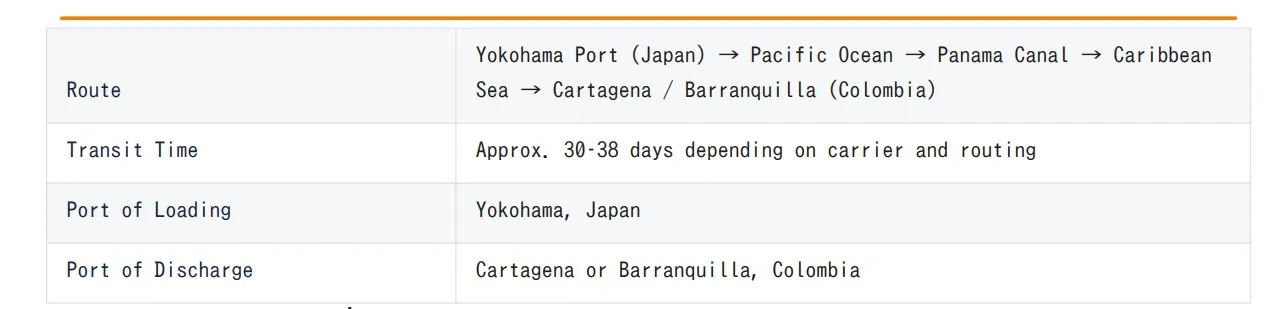
Yokohama is one of Japan's premier export ports for heavy machinery, offering regular sailings to Latin American ports and excellent logistics infrastructure for flat rack and breakbulk cargo.
We Ship to All of Latin America — Not Just Colombia
This shipment was bound for Colombia, but we export used construction machinery to buyers across the entire Latin American and Caribbean region.
Countries We Regularly Export to in the Americas:
South America: Colombia, Ecuador, Peru, Chile, Bolivia, Brazil, Argentina, Venezuela, Paraguay, Uruguay, Guyana, Suriname.
Central America & Caribbean: Panama, Costa Rica, Guatemala, Honduras, El Salvador, Nicaragua, Dominican Republic, Jamaica, Trinidad & Tobago.
Mexico: Full export service available
Machines We Can Source and Export:
Hydraulic Excavators: Caterpillar, Komatsu, Hitachi, Kobelco, Volvo, Doosan
Wheel Loaders: Komatsu, Caterpillar, TCM Bulldozers Komatsu, Caterpillar
Motor Graders: Komatsu, Caterpillar
Cranes: Tadano, Kato, Maeda (Rough Terrain / All Terrain)
Dump Trucks: Nissan, Hino, Isuzu, Mitsubishi
Shipping Options: Flat Rack, FCL Container, RoRo, LCL
Looking to Import Machinery from Japan to Colombia or Latin America?
If you found this post because you're searching for a reliable exporter of used Japanese construction equipment — Caterpillar, Komatsu, Hitachi, or any other brand — we're happy to help. We don't just sell machines. We handle the full export process: sourcing, inspection, cleaning, certification, loading, and documentation. When your machine arrives at port, everything is in order.
・ Machines sourced from trusted yards across Japan
・ Pre-export inspection with photo report
・ Full cleaning to meet biosecurity requirements
・ Radiation safety certificate included
・ Flat rack, FCL, and RoRo shipping available
・ Export documentation handled start to finish
・ English-speaking team
Get in touch today — tell us what you need, and we'll put together a quote.